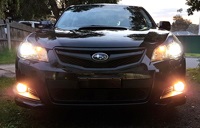
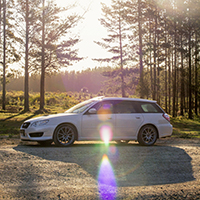
So, I can finally share images of the fitment of my bonnet vent prototypes.
Here are the vents, prior to painting, sat in the freshly cut holes of the cheap, sad-looking bonnet I bought some time back:

And here is the post-painted and riveted completed project (for now).

These are prototypes only. The final version will be 3D printed in nylon, as nylon is fairly fine with heat. That said, final material selection for the prints will be made rather whimsically, as it'll depend on the price and heat resistant characteristics of the selected material at the time of ordering.
I'll be opening up the holes in the bonnet to accept a plastic peg (that is part of the print) in lieu of the riveting of holes. This way the pegs will accept some sort of retainer clip underneath and the finish on top of the bonnet is smooth and as flush as possible. The rivets just look too back-yard-hack-ish. Which is what it is, but doesn't need to look like it

Now, empirical data:
@ 30°C ambient temperatures, max water and oil temps, whilst sitting in traffic, rise to mid nineties: I've seen 94°C for water and 96°C for oil. It doesn't rise beyond this. Looking at traffic through a column of heat haze is very satisfying. Under-bonnet temps rise to over 50*C (my gauge's max for these two sensors) sitting in traffic too, but cool to low forties when travelling at 60kph for a few minutes. Oil and water cool to low-to-mid eighties when travelling at 60kph for a few minutes, too. The under-bonnet temps used to climb into the 50+°C range and never return under all conditions prior to fitting the vents. I have noticed that 60kph is the minimum speed to start to reduce temps. This must be when the Bernoulli effect starts to draw air out through the vents properly.
I can confidently say that my rig is now Queensland-proof as far a general heat management goes

As far a water management goes, the vents ended up sitting further forward than I had feared and only expose the very front of the power steering pump, alternator and A/C compressor. It essentially has the pulleys and drive belt exposed. One day, whilst parked at work, it drizzled all day and the water ingress was as expected, but to very little detrimental effect. It started up just fine. One pulley had a tiny smidge of surface rust on it that the belt would have eaten quick-smart.
The 3D printed versions won't be louvered. The rear surface will extend forward and the internal opening will be more of an internal snout, with the rear surface draining water in front of the drive belt, into the gap behind the fans. This will also neaten up the look and make it seem more OEM, IMHO.
All in all, I am very stoked that this has worked as well has it has. I shall post images of my final design when completed.